Social Media Marketing Strategies for Beginners: A Complete Guide to Growing Your Online Presence
In today’s highly competitive digital landscape, social media has become an essential tool for businesses to connect with their audiences, promote their products or services, and build a strong brand identity. Learning Social Media Marketing Strategies for Beginners is a crucial step toward establishing a successful online presence, reaching the right audience, and growing your business. Whether you are a small business owner, entrepreneur, freelancer, or startup founder, understanding these strategies can help you increase brand awareness, attract potential customers, and promote your business effectively without spending a huge amount on marketing.
As a best digital marketer in Perinthalmanna, I understand the importance of implementing effective social media marketing techniques to improve business visibility and attract potential clients. Platforms such as Instagram, Facebook, YouTube, and LinkedIn offer valuable opportunities for businesses to connect directly with their target audience, showcase their services, promote their products, and build lasting customer relationships.
However, successful social media marketing involves more than simply creating an account and publishing posts. It requires a clear understanding of your target audience, consistent content creation, meaningful engagement, choosing the right social media platforms, and regularly analysing marketing performance. In this guide, we will explore practical Social Media Marketing Strategies for Beginners to help you strengthen your online presence, increase engagement, reach potential customers, and achieve sustainable business growth.
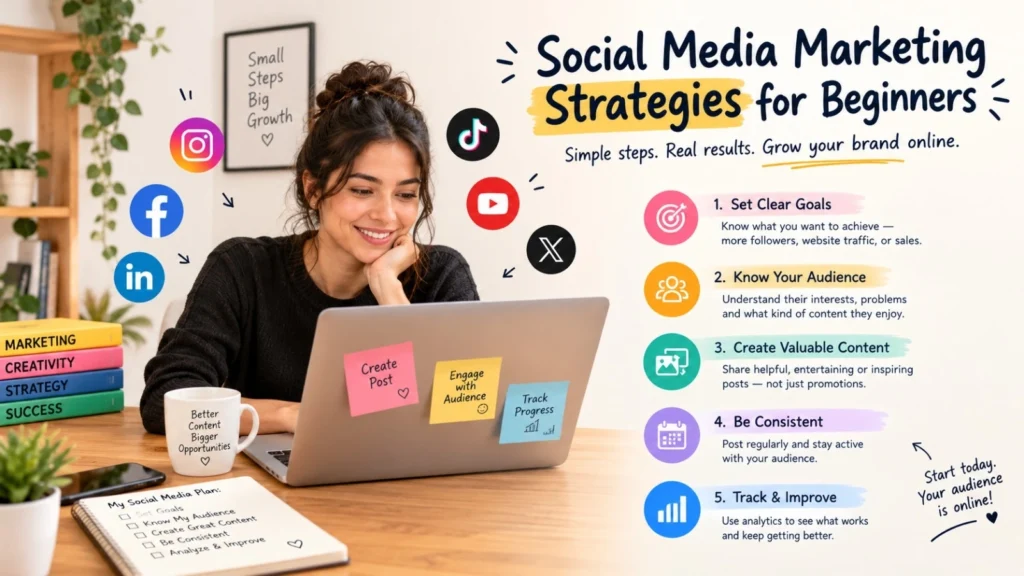
1. Understand Your Business Goals and Objectives
Define Your Social Media Marketing Goals
Before starting any social media marketing campaign, it is important to identify what you want to achieve. One of the most effective Social Media Marketing Strategies for Beginners is setting clear marketing goals. Having well-defined objectives helps you choose the right social media platforms, create relevant content, reach your target audience, and measure your marketing performance.
Every business has different marketing goals. Some businesses focus on increasing brand awareness, while others aim to generate leads, drive website traffic, attract new customers, or increase sales. Understanding your business requirements will help you develop a social media strategy that delivers better results.
Some common social media marketing goals include:
Increase Brand Awareness: Make more people familiar with your business, products, and services.
Gain More Followers: Attract new audiences and build a strong social media community.
Generate Quality Leads: Encourage potential customers to make enquiries about your products or services.
Drive Website Traffic: Bring visitors from social media platforms to your business website.
Promote Products and Services: Showcase your offerings through engaging posts, videos, and promotional campaigns.
Build Customer Relationships: Improve communication, customer engagement, and brand loyalty.
Increase Sales and Conversions: Turn social media followers into paying customers.
When setting your marketing goals, make sure they are specific, measurable, achievable, relevant, and time-bound (SMART goals). For example, instead of simply aiming to increase your Instagram followers, set a target to gain 500 genuine followers within three months or generate 30 potential customer enquiries every month.
Setting clear objectives is one of the most important Social Media Marketing Strategies for Beginners because it provides direction, helps track progress, and makes it easier to improve your marketing campaigns for long-term business growth.
2.Identify and Understand Your Target Audience
It is imperative to possess a profound comprehension of the identity of prospective clientele, their specific areas of interest, and the digital platforms they utilize with the greatest frequency.
Start by identifying your audience based on:
– Age and gender.
– Location and language.
– Interests and hobbies.
– Online behaviour.
– Shopping preferences.
– Problems and customer needs.
Consequently, proprietors of fashion enterprises should direct their efforts toward individuals captivated by apparel, stylistic nuances, and evolving trends, whereas providers of digital solutions ought to focus on business owners, entrepreneurs, and startups seeking to enhance their online visibility.
Conducting an analysis of your competitors is equally valuable, as it illuminates the specific types of content that garner significant attention within your sector.
A profound comprehension of your target audience empowers you to craft content that resonates deeply with their specific interests, thereby fostering meaningful engagement and driving active participation in your business initiatives.
3. Choose the Right Social Media Platforms
By identifying and leveraging the most pertinent channels, organizations can effectively penetrate their target demographics while simultaneously optimizing their allocation of time, labor, and financial resources.This targeted approach further empowers businesses to concentrate exclusively on the platforms that present the most lucrative avenues for advancing their products and services.
Each social media ecosystem possesses distinct functionalities, demographic compositions, and marketing potentials, rendering a comprehensive understanding of their operational mechanics indispensable for selecting the optimal channels to advance commercial interests, engage prospective clientele, and fulfill strategic marketing goals.
In this discourse, we shall examine several of the most prominent social media platforms and delineate the strategies by which commercial entities can leverage them with efficacy.
For enterprises prioritizing visual storytelling and brand cultivation, Instagram serves as a premier digital ecosystem.
It facilitates the curation of product portfolios, the dissemination of dynamic Reels, the deployment of ephemeral Stories, and the establishment of direct client engagement via Instagram Direct Messages.By leveraging targeted hashtags, forging strategic partnerships with influencers, and disseminating innovative content, organizations can significantly amplify their market presence and cultivate a robust, expanding audience.
Facebook serves as a potent instrument for cultivating communities, advancing local enterprises, disseminating business developments, and executing precision–targeted advertising initiatives.
By leveraging Facebook Business Pages and Groups, organizations can forge connections with prospective clients, distribute valuable content, address inquiries, and nurture enduring customer relationships.
YouTube
YouTube stands as a paramount channel for video marketing, enabling enterprises to disseminate tutorials, product demonstrations, educational materials, customer testimonials, and informational content designed to capture viewer attention and fortify brand credibility.
Furthermore, a consistent regimen of publishing high–value video assets facilitates market expansion by enhancing visibility within YouTube’s search results, thereby attracting new audiences.
LinkedIn proves especially instrumental in the realms of professional services, B2B marketing, strategic networking, and the cultivation of personal brands.
It serves as a pivotal platform for enterprises and individuals to forge connections with industry luminaries, key decision–makers, prospective clients, and peers.By disseminating sector–specific expertise and delivering insightful commentary, professionals can effectively cement their authority and forge a robust professional reputation.
Pinterest constitutes a highly strategic asset for enterprises operating within sectors such as creativity, fashion, beauty, graphic design, interior decoration, and lifestyle goods.
By disseminating compelling visual pins, businesses can effectively exhibit their product offerings, amplify the visibility of blog content, and drive substantial website traffic.This approach enables organizations to connect with an audience actively seeking inspiration and novel concepts, thereby aligning marketing efforts with user intent.
Which Social Media Platforms Should Beginners Choose?
Rather than attempting to navigate the complexities of numerous social media platforms in unison, novices ought to dedicate their efforts to mastering two or three channels that most effectively align with their corporate objectives and demographic profile.
Illustratively, enterprises within the fashion and beauty sectors stand to gain significantly from leveraging Instagram and Pinterest, whereas practitioners of professional services are more likely to derive optimal outcomes by cultivating a presence on LinkedIn and Facebook.
Strategically selecting the appropriate digital platforms empowers enterprises to hone their marketing initiatives, curate pertinent content, and establish meaningful connections with audiences possessing a high propensity for conversion.
Consequently, the meticulous selection of suitable channels constitutes a foundational element within Social Media Marketing Strategies for Beginners; this critical step not only facilitates the cultivation of a robust online presence and the enhancement of audience engagement but also serves as a catalyst for achieving enduring business growth.
4. Create a Strong Social Media Marketing Strategy
Create a Social Media Marketing Strategy
Cultivating a prosperous social media presence necessitates meticulous planning underpinned by a definitive marketing strategy.
Merely disseminating sporadic content devoid of a structured approach is unlikely to yield consistent outcomes.Consequently, among the most efficacious Social Media Marketing Strategies for Beginners lies the formulation of a comprehensive content and marketing blueprint prior to commencing publication activities.
A well-defined strategy illuminates the requisite content types, optimal publication timing, methods for audience engagement, and metrics for evaluating marketing efficacy, while simultaneously guaranteeing that every social media initiative aligns seamlessly with overarching business objectives.
The following are the critical components that must be integrated into your social media marketing strategy:
Content Strategy formulation involves determining the specific modalities for publication—including static imagery, video narratives, Reels, ephemeral Stories, instructional material, promotional messaging, and client endorsements.
Concurrently, one must establish a consistent posting schedule to ensure sustained engagement and reliability.
Upholding brand consistency entails preserving a unified identity across every social media channel.
By deploying harmonious colour palettes, typographic treatments, logos, graphic designs, and a coherent communication style, the enterprise ensures it remains instantly recognizable to its audience.
Establishing a pragmatic social media content calendar is essential for orchestrating your posts with foresight, thereby ensuring consistent scheduling, eliminating the pressures of ad hoc planning, and sustaining a vibrant digital footprint.
Audience Engagement: Develop a strategy for fostering interaction with your following by actively responding to comments, replying to direct messages, resolving customer inquiries, and immersing yourself in ongoing discussions.
Establish precise objectives for each marketing campaign and content initiative by determining whether the primary aim is to amplify brand visibility, cultivate deeper audience engagement, solicit qualified leads, direct web traffic, or boost revenue.
Consistently evaluate the efficacy of your social media initiatives by leveraging native platform insights and comprehensive analytics.
Scrutinize pivotal indicators—including reach, impression counts, engagement rates, follower acquisition velocity, website traffic referrals, and conversion events—to derive actionable intelligence regarding optimal content strategies.
A meticulously crafted social media strategy not only conserves valuable time and elevates the caliber of content but also guarantees that a brand disseminates a cohesive message to its audience.
Adhering to these procedural steps constitutes a pivotal component of social media marketing strategies for novices, thereby facilitating the cultivation of a more robust online presence and the attainment of superior marketing outcomes.
.
5. Create High-Quality and Valuable Content
Effective posts must captivate audiences, deliver substantive value, and actively stimulate user engagement with the brand.
Focus on creating content that solves problems, answers questions, entertains your audience, or introduces your products and services.
Some effective content formats include:
*Educational Content:* Disseminate practical advice, step-by-step tutorials, sector–specific insights, and informative articles.
Utilize this platform to effectively highlight your products, services, special offers, and recent launches.
*Behind-the-Scenes Content:* Give your audience a look at your workplace, production process, or daily business activities.
Customer testimonials, obtained with explicit permission, serve to authentically convey real client feedback and personal experiences.
To foster active engagement, integrate interactive elements such as polls, quizzes, targeted inquiries, and discussion forums, thereby compelling the audience to participate meaningfully.
*Entertainment Content:* Craft engaging and relatable posts that resonate deeply with your target audience.
For the graphic designer or business proprietor, the caliber of visual presentation holds equal significance to other operational facets.
To elevate the professional stature of your content, one must employ compelling aesthetic compositions, legible typographic systems, premium imagery, and a cohesive branding framework.
Prioritize the caliber and pertinence of your contributions over the sheer volume of output.
6. Use Short-Form Videos to Increase Engagement
Short–form video content has emerged as a pivotal component of contemporary social media marketing strategies.
Platforms such as Instagram Reels, YouTube Shorts, and Facebook Reels offer distinctive avenues for businesses to expand their reach and engage novel demographics.
Videos prove their efficacy by facilitating the rapid dissemination of information while simultaneously sustaining viewer engagement.
Here are several video content concepts tailored for beginners:
– Product demonstrations.
– Quick educational tips.
– Frequently asked questions.
– Business introductions.
– Behind-the-scenes videos.
– Customer success stories.
– The juxtaposition of pre- and post–transformation states.
– Tutorials and how-to guides.
Commence your video productions with a compelling introduction designed to captivate the audience and sustain their attention throughout the content.
Ensure your core message is articulated with precision, accompanied by legible captions for accessibility, and conclude by integrating a pertinent call to action that directs viewers toward the desired outcome.
Professional–grade cameras and elaborate equipment are not prerequisites for producing valuable video content; rather, a combination of a smartphone, adequate illumination, crisp audio, and inventive conceptualization suffices to launch an effective production
7. Maintain a Consistent Posting Schedule
Consistently publishing content at the expense of its quality can detrimentally impact your overarching strategy; therefore, it is imperative to establish a dissemination schedule that aligns precisely with your temporal and resource constraints.
A novice–oriented weekly content schedule might be structured as follows:
– Monday: Educational content or marketing tips.
– Tuesday is dedicated to the presentation of products or services.
– Wednesday: Short–form video or Reel.
– Thursday is dedicated to presenting a customer testimonial or review.
– Friday features an informative carousel post.
– Saturday: Promotional content.
– Sunday: Interactive stories or audience questions.
You may draft your content ahead of time and leverage scheduling tools to systematically organize your publishing initiatives.
Analyze your audience demographics to discern peak engagement periods, then calibrate your content publication timeline to align with these windows of maximum activity.
8. Use Hashtags and Keywords to Improve Discoverability
By strategically employing targeted search terminology, creators can significantly enhance the visibility of their posts, thereby increasing the probability of their material surfacing in relevant query results.
Choose hashtags related to your business, industry, location, and content topic.
For instance, a digital marketing specialist based in Malappuram might leverage:
– #DigitalMarketing
– #SocialMediaMarketing
– #DigitalMarketingKerala
– #MalappuramBusiness
– #ContentMarketing
– #KeralaEntrepreneurs
Beyond the strategic deployment of hashtags, it is imperative to integrate pertinent keywords organically across captions, profile biographies, video titles, and content descriptions.
For example, if you provide graphic design services, use relevant phrases such as graphic design services, logo design, branding, and social media poster design.
Avoid keyword stuffing and irrelevant hashtags.
Your content should always sound natural and provide value to the audience.
9. Engage With Your Audience and Build Trust
Social media transcends its role as a mere advertising vehicle; it serves as a vital arena wherein enterprises can cultivate profound, enduring connections with their clientele.
Fostering engagement enables organizations to discern customer requirements, address inquiries, and cultivate a more profound rapport with their audience.
You can improve engagement by:
– Engaging consistently with feedback.
– The expedited response to direct messages.
– Do your captions pose inquiries?
– Administering surveys and interactive assessments.
– Sharing customer feedback.
– Encouraging followers to share their opinions.
– Appreciating customers who mention your business.
Cultivate a communication style that is both friendly and professionally astute; when clients perceive genuine attentiveness, they are predisposed to establish trust in your enterprise and seriously consider your offerings.
Cultivating trust is an endeavor that demands patience, yet it ultimately yields enduring advantages for your brand.
10. Explore Paid Social Media Advertising
Businesses can leverage platforms like Meta Ads Manager to execute advertising campaigns spanning both Facebook and Instagram.
Campaigns may be architected around a diverse array of distinct objectives, encompassing:
*Brand Awareness*: Expand your enterprise‘s visibility by exposing it to a broader audience.
*Traffic:* Encourage users to visit your website or landing page.
To enhance audience participation, you should strategically amplify engagement levels across your social media channels.
The lead generation process involves systematically capturing inquiries from prospective clients via dedicated lead intake forms.
Sales entail the promotion of products and the stimulation of consumer purchases.
Prior to allocating funds toward advertising initiatives, it is imperative to definitively ascertain both the target demographic and the overarching campaign objectives.
Subsequently, develop compelling advertisements that articulate a lucid message and incorporate robust calls to action.
Commence with a fiscally prudent budget, systematically evaluate diverse creative assets, and rigorously track campaign metrics.
It is imperative to refrain from allocating funds until the advertising objectives have been clearly defined and comprehensively understood.
The efficacy of paid advertising is maximized when it is strategically integrated with high–quality organic content and a meticulously optimized business profile.
11. Track Your Performance Using Analytics
Successful social media marketing involves continuously measuring and improving your results. Analytics help you understand how your content performs and whether your marketing activities are achieving their objectives.
Most social media platforms provide built-in analytics tools that offer valuable information about audience behaviour and content performance.
Some important metrics to monitor include:
*Reach:* The number of unique people who see your content.
*Impressions:* The total number of times your content is displayed.
*Engagement Rate:* The level of interaction your content receives compared with its reach or audience size.
*Follower Growth:* How your social media audience changes over time.
*Website Traffic:* The number of visitors coming to your website through social media.
*Click-Through Rate:* The percentage of people who click on your links after seeing your content or advertisement.
*Conversions:* The number of people completing valuable actions such as purchases, registrations, or enquiries.
Review your analytics regularly to identify successful content formats and areas that need improvement.
Do not measure your success only by likes and followers. Focus on the results that directly support your business objectives.
12. Build a Strong Brand Identity Across Platforms
Establishing a cohesive brand identity ensures that your enterprise remains instantly recognizable, thereby facilitating customer recall of your offerings and services.
Your social media profiles must consistently project a unified brand persona, adhering to coherent core values and a distinctive visual aesthetic.
Maintain consistency in:
– Logo and brand colours.
– Typography and graphic elements.
– Profile and cover images.
– Content design and presentation.
– Tone of voice and communication.
– Business descriptions and contact information.
For instance, a high–end fashion house might employ minimalist aesthetics, sophisticated typography, and polished product imagery, whereas a food brand targeting a younger demographic could leverage vivid color palettes, inventive graphics, and engaging video content.
A robust visual identity not only fosters a professional demeanor but also effectively distinguishes your enterprise from rival entities.
13. Use Social Media to Drive Website Traffic and Generate Leads
Social media channels ought not to function in isolation from the broader spectrum of your digital marketing strategy; rather, they must be seamlessly integrated to maximize efficacy.
By establishing robust connectivity between your social media platforms and your corporate website, you can significantly amplify the generation of prospective business opportunities.
Integrate your website URL into all social media profiles to guide audiences toward pertinent service portals, product listings, blog articles, or contact forms.
Furthermore, disseminating your blog posts, curated resources, portfolio projects, and business announcements serves as an effective strategy to drive traffic and encourage visitors to delve deeper into your website.
Use clear calls to action such as:
– For further information, please consult our website.
– Please reach out to us to engage our professional services.
– Delve into our most recent offerings.
– Please contact us to submit any inquiries.
– Please consult our most recent blog to access a wealth of practical insights.
Ensure your website is optimized for mobile devices, features intuitive navigation, and delivers concise, transparent information regarding your business operations.
Synergizing social media marketing strategies with comprehensive website optimization not only fortifies your digital footprint but also significantly enhances the prospects of acquiring new customers.
## Common Social Media Marketing Mistakes Beginners Should Avoid
Initiating a social media marketing campaign frequently leads novices to commit errors that can significantly undermine their outcomes; however, recognizing these pitfalls is instrumental in crafting a more robust and effective strategy.
Publishing content without a coherent strategic framework risks diluting your brand‘s core message, as the absence of defined marketing objectives renders the dissemination of information arbitrary and directionless.
*2.
Ignoring Audience Engagement:* Not responding to comments and messages can reduce customer trust.
3.
Prioritizing Follower Count Exclusively: Possessing a substantial audience does not invariably translate into increased clientele or superior business outcomes.
The employment of substandard imagery and erratic design elements risks projecting an unprofessional demeanor.
The relentless proliferation of product promotions, devoid of substantive or engaging material, risks causing audiences to disengage.
*6.
Neglecting Analytics:* In the absence of performance metrics, discerning the efficacy of specific strategies becomes increasingly elusive.
*7.
Anticipating Immediate Outcomes:* Cultivating an audience on social media demands a commitment to patience, steadfast consistency, and the relentless pursuit of iterative enhancement.
Steering clear of these pitfalls will facilitate the cultivation of a more efficacious marketing strategy, thereby forging a more robust resonance with your target audience.
Conclusion: Social Media Marketing Strategies for Beginners to Build a Successful Brand
Whether one is engaged in delineating a target demographic, selecting optimal platforms, crafting compelling content, executing targeted advertising campaigns, or evaluating performance metrics, each strategic initiative serves as a critical component in driving comprehensive marketing efficacy.
Successful social media marketing does not hinge on ubiquitous platform presence or the illusion of overnight viral fame; rather, it rests upon the strategic capacity to engage specific target demographics, disseminate substantive content, uphold unwavering communication consistency, and cultivate authentic, enduring relationships.
Begin by employing straightforward tactics, testing diverse content formats, and consistently assessing outcomes.
As your expertise expands, you will be positioned to architect more sophisticated campaigns, thereby enhancing your overall digital marketing efficacy.
For entrepreneurs, freelancers, startup proprietors, and owners of small enterprises, deploying the appropriate social media marketing strategies is instrumental in amplifying brand visibility, cultivating a pipeline of prospective clients, and unlocking novel avenues for commercial expansion.
Commence your social media marketing endeavor immediately by maintaining unwavering consistency, thereby transforming your digital footprint into a potent instrument for accelerating business expansion.
Pingback: Why every business needs a website